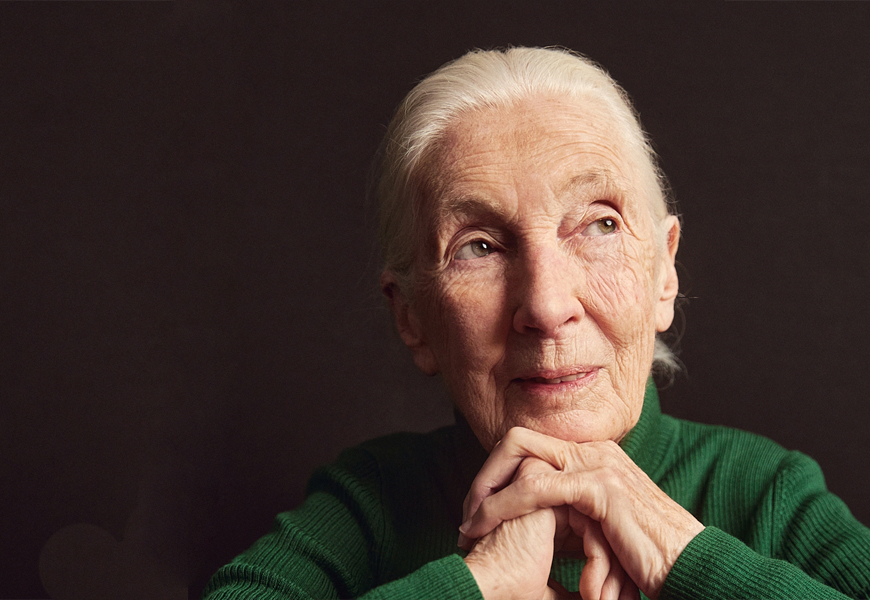
Jane Goodall, the famed primatologist, anthropologist and conservationist, has died, according to the institute she founded. She was 91 years old.
Goodall died of natural causes while in California on a speaking tour of the United States, the institute said in a statement on social media on Wednesday, October 1, 2025.
Godall’s “discoveries as an ethologist revolutionized science, and she was a tireless advocate for the protection and restoration of our natural world,” according to the institute.
It’s true. Few names in science were as universally recognized as Goodall. She began as an outsider to academia and went on to become one of the most influential scientists and environmentalists of the 20th and 21st centuries.
She was only 26 years old when she first entered Tanzania and began her important research on chimpanzees in the wild. Throughout her study of the species, Goodall proved that primates display an array of similar behaviours to humans, such as the ability to develop individual personalities and make and use their own tools. Ultimately, the soft-spoken British primatologist changed the way the world understands chimpanzees—and, by extension, ourselves.
But beyond the iconic image of Goodall in the Tanzanian forest with a notebook and binoculars lies a story filled with surprising twists. In remembrance of the late, great Jane Goodall, here are ten things that you might not know about the woman who redefined primate research.
1. She went to Africa without a degree
When Goodall arrived in what was then Tanganyika (now Tanzania) in 1960, she had no university degree—only a secretarial diploma and a lifelong fascination with animals. Louis Leakey, the famed paleoanthropologist, hired her as his secretary but quickly realized her potential as a field researcher. It was almost unheard of at the time for someone without formal scientific training to lead such a study.
2. She discovered chimps use tools
One of Goodall’s most groundbreaking observations came early in her career: she watched a chimpanzee strip leaves off a twig and use it to fish termites out of a mound. At the time, tool use was considered uniquely human. Her discovery forced scientists to redefine what separated humans from other animals.
3. She named her subjects—against scientific convention
Most researchers used numbers to identify their study animals to avoid “bias,” but Goodall gave her chimps names like David Greybeard, Flo, and Fifi. This personalized approach drew criticism at first but ultimately helped the public connect emotionally with her work and laid the groundwork for more empathetic animal research.
4. Her early funding came from National Geographic
Goodall’s fieldwork was so compelling that National Geographic began financing it in the early 1960s and sent a photographer, Hugo van Lawick, to document her studies. Van Lawick later became her husband. His stunning photos and films of Goodall and the chimps made her a global celebrity.
5. She challenged the myth of “gentle” chimps
In the 1970s, Goodall documented violent intergroup conflict among chimpanzees—including what she called the “Four-Year War” between two rival communities. This was shocking at the time; chimps had been popularly portrayed as peaceable creatures. Her findings added complexity to our understanding of primate behavior, aggression, and even the evolutionary roots of human violence.
6. She created the roots & shoots program
Beyond her scientific achievements, Goodall is a tireless advocate for conservation and youth empowerment. In 1991, she founded Roots & Shoots, a global program that engages young people in community service and environmental projects. Today it’s active in more than 60 countries.
7. She had been a UN Messenger of Peace since 2002
In recognition of her environmental and humanitarian work, the United Nations appointed Goodall as a Messenger of Peace in April 2002. Up until her death, she used the platform to speak out on issues from biodiversity loss to climate change and the rights of indigenous communities.
8. She was also a vegetarian activist
Goodall is a committed vegetarian (and more recently vegan) who speaks openly about the environmental impact of industrial farming. She often links her work on animal welfare and habitat conservation to the choices people make at the dinner table.
9. Her work helped establish Gombe Stream National Park
What began as a small research station evolved into Gombe Stream National Park in 1968, ensuring a level of protection for the chimpanzees she studied. Goodall’s work has inspired similar conservation efforts across Africa.
10. She worked until the end of her life
Born on April 3, 1934, Goodall turned 91 earlier this year, and continued to travel extensively (often more than 300 days a year) to lecture, meet young activists, and raise funds for conservation. In fact, her stamina and optimism had become as legendary as her science. She had been in California when she died on October 1, 2025, where she was visiting as part of a speaking tour in the U.S.